Early childhood is a time when children learn through observation, interaction, movement, play and exploration. While traditional learning helps children develop early academic skills, creative experiences such as arts and music for kids can make the learning journey more engaging and meaningful.
Kids grooming with arts and music is not simply about teaching a child to draw, paint, sing or dance. It is about creating opportunities for children to express themselves, explore ideas, communicate with others, develop confidence and build age-appropriate skills through enjoyable experiences.
Art, music, movement, storytelling and creative play can become valuable parts of early childhood education when they are introduced in an age-appropriate and purposeful way.
At BrainBunny Juniors, preschool learning combines play-based learning, activity-based experiences, creative activities, storytelling, music and movement, art and craft, hands-on exploration and other age-appropriate learning experiences.
Quick Answer: How Do Arts and Music Help Children?
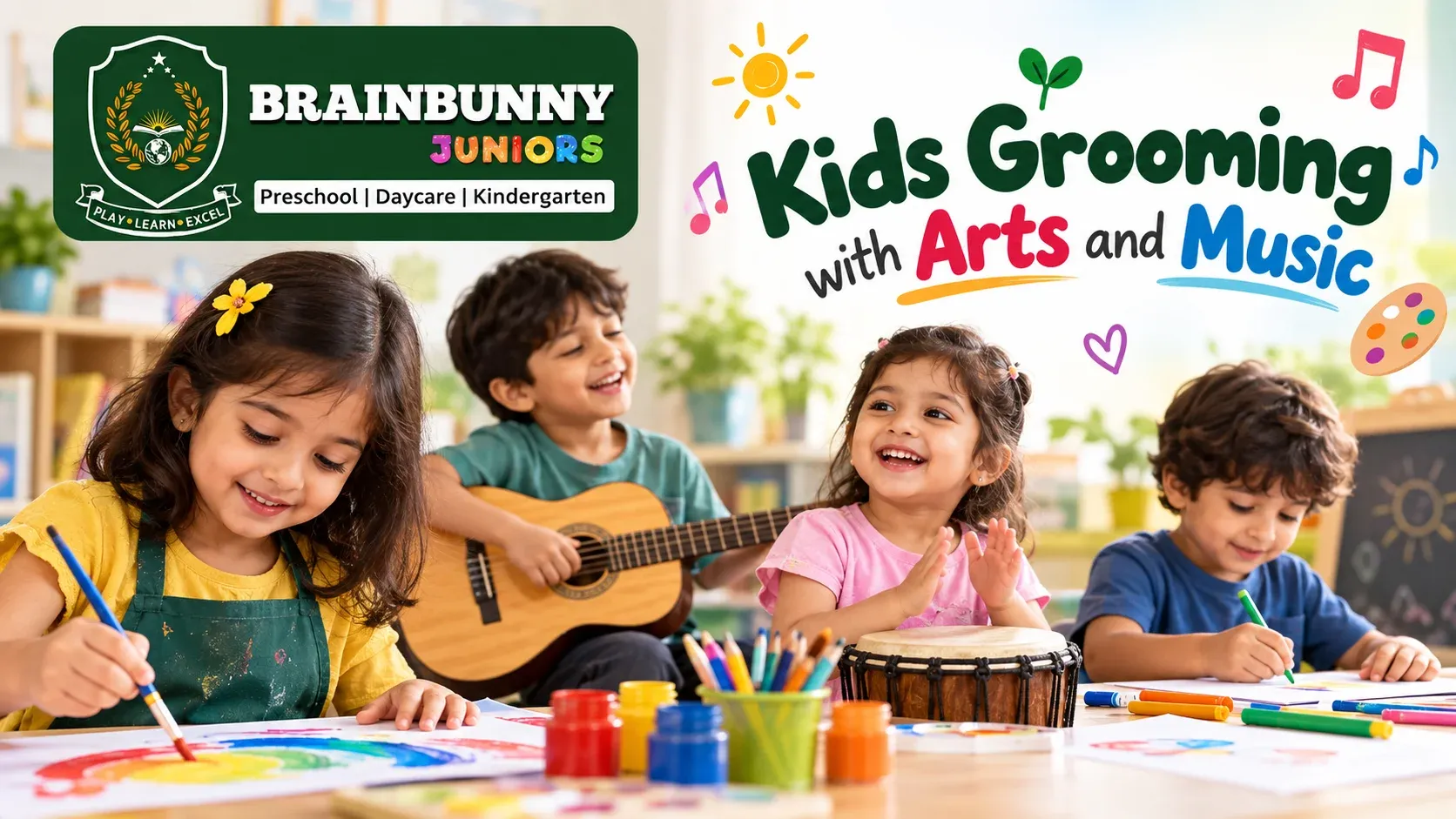
Arts and music can support several areas of early childhood development. Drawing, painting, colouring and craft activities can encourage creativity, fine motor practice and self-expression, while music, singing, rhythm and movement can support listening, participation, coordination and communication.
When these experiences are included alongside play-based and activity-based learning, children get opportunities to learn by doing, expressing ideas and interacting with others.
For preschool-age children, the goal is not perfection or performance. The focus is on participation, exploration, creativity, confidence and joyful learning.
What Does Kids Grooming Through Arts and Music Mean?
The word "grooming" in early childhood education can be understood as helping children gradually develop positive habits, confidence, communication, creativity, social skills and independence.
When arts and music are used as part of this process, children can explore different ways of learning and expressing themselves.
For example:
- Drawing can encourage children to express ideas visually.
- Painting can introduce colours, patterns and creative exploration.
- Music can encourage listening and rhythm.
- Singing can support language and participation.
- Dance and movement can encourage coordination and physical activity.
- Storytelling can develop imagination and communication.
- Role play can encourage expression, cooperation and creativity.
- Group activities can give children opportunities to interact and participate.
These experiences work best when they are appropriate for the child's age and developmental stage.
At BrainBunny Juniors, creative activities, music and movement, storytelling, art and craft and hands-on learning are part of the broader preschool learning approach.
Why Are Arts and Music Important for Children?
Children do not learn in only one way. Some concepts can be introduced through stories, some through movement, some through visual activities and others through sound and rhythm.
Arts and music provide additional ways for children to participate in learning.
1. Arts Encourage Creativity
Art gives children opportunities to make choices and experiment.
A child may choose a colour, create a shape, draw a picture or combine different materials. The process encourages exploration and imagination.
The finished drawing does not have to look perfect. The important part is that the child has an opportunity to create and communicate an idea.
2. Music Encourages Listening and Participation
Songs, rhythms and movement activities can encourage children to listen carefully, follow simple instructions and participate in group activities.
Music can also make routine learning experiences more engaging for young children.
3. Creative Activities Encourage Self-Expression
Young children may not always have the vocabulary to explain exactly what they are thinking or feeling.
Drawing, music, movement, storytelling and role play can provide additional ways for children to express themselves.
4. Arts and Music Make Learning Interactive
Instead of only listening to an explanation, children can participate.
They can:
- Sing a song
- Move to a rhythm
- Draw a picture
- Build something
- Act out a story
- Explore colours
- Participate in group activities
This hands-on participation can make early learning more engaging.
Benefits of Arts and Music for Kids
Arts and music can contribute to several areas of early childhood learning and development when used appropriately.
1. Creativity and Imagination
Creative activities give children opportunities to think beyond a single expected answer.
A blank sheet of paper can become a house, a tree, a family, an imaginary character or something completely different.
Music can similarly encourage children to explore rhythm, sounds and movement.
Creative experiences can therefore support imagination and flexible thinking.
2. Fine Motor Practice
Activities such as:
- Drawing
- Colouring
- Painting
- Cutting with child-safe materials
- Pasting
- Clay or dough activities
- Collage
- Simple craft work
can provide opportunities for children to practise hand and finger movements.
These activities can complement other preschool experiences that support fine motor development.
BrainBunny Juniors specifically includes art and craft activities such as drawing, painting and creative crafts as part of its child-development activities.
3. Communication Skills
Music, storytelling, role play and group activities create opportunities for children to listen and communicate.
For example, children may:
- Repeat words from a song
- Answer questions about a story
- Talk about their artwork
- Participate in a group song
- Describe colours and objects
- Act out a simple situation
These interactions can support language and communication development.
4. Confidence and Participation
A child who is encouraged to share a drawing, sing a song or participate in a group activity gets opportunities to practise expressing themselves.
Over time, positive participation can help children become more comfortable communicating in group settings.
The goal should not be to force children to perform. Children should be encouraged to participate according to their age, comfort level and individual personality.
5. Social Interaction
Arts and music can also be group experiences.
Children may work together on a craft, sing a song as a group, participate in movement activities or create a simple classroom project.
These experiences provide opportunities to practise:
- Sharing
- Taking turns
- Listening
- Cooperating
- Following group instructions
- Respecting others' ideas
6. Emotional Expression
Children experience emotions every day, but they may not always have the words to explain them.
Creative activities can give children additional forms of expression.
A child may use colours, drawings, movement, music or pretend play to communicate an idea or feeling.
Adults can use these moments as opportunities to talk with children about emotions in a supportive and age-appropriate way.
How Art Supports Child Development
Art is more than colouring a picture.
A thoughtfully planned art activity can combine creativity with language, motor practice, observation and social interaction.
For example, a preschool teacher might ask children to create a picture of a rainy day.
Children can:
- Talk about rain.
- Identify colours.
- Draw clouds.
- Add raindrops.
- Describe their pictures.
- Listen to classmates.
- Display their artwork.
One activity can therefore create opportunities for several forms of learning.
Art Activities for Preschoolers
Age-appropriate activities may include:
- Drawing
- Free colouring
- Finger painting
- Colour mixing
- Paper collage
- Clay or dough modelling
- Nature-inspired art
- Simple craft projects
- Pattern activities
- Puppet making
- Story-based drawing
The exact activity should depend on the child's age and ability.
For younger children, the process should generally be simple and exploratory. Older preschoolers can gradually participate in more structured creative projects.
Music and Movement Activities for Kids
Music does not have to mean sitting quietly and listening.
For preschoolers, music can involve the whole body.
A teacher might play a simple rhythm and ask children to:
- Clap
- Tap
- Walk
- Jump
- Freeze
- Turn
- Move slowly
- Move quickly
- Follow an action
Such activities can combine music, movement and participation.
They can also make classroom routines more enjoyable.
At BrainBunny Juniors, music and movement activities are described as part of the preschool methodology, alongside play-based learning, creative thinking, storytelling and art and craft activities.
How Arts and Music Build Creativity
Creativity develops when children are given opportunities to explore, make choices and try different approaches.
For example, instead of asking every child to make exactly the same drawing, a teacher can introduce a topic and allow children to interpret it in their own way.
Similarly, a music activity can allow children to experiment with rhythm, movement or sounds.
This type of learning encourages children to think:
- What can I create?
- What happens if I try another colour?
- Can I make a different sound?
- How can I move to this rhythm?
- What happens next in the story?
- How can I show my idea?
These simple questions can encourage curiosity and creative thinking.
Arts and Music for Confidence and Self-Expression
Confidence in young children can develop through everyday opportunities to participate.
A child may initially be hesitant to speak in a group. A familiar song or simple art activity may provide a more comfortable way to participate.
For example:
Art:
"Tell us about your picture."
Music:
"Would you like to clap along?"
Storytelling:
"What do you think happens next?"
Role play:
"Would you like to be the shopkeeper?"
These small opportunities can help children practise communication and participation without making every activity feel like a performance.
A child should be encouraged rather than compared with other children.
Arts and Music in Early Childhood Education
A strong preschool experience can combine creative activities with language, numeracy, movement, social interaction and everyday learning.
Arts and music do not have to be separate from academic learning.
They can complement it.
Example: Learning Colours Through Art
Children can learn about colours while painting.
Example: Learning Numbers Through Music
Children can count claps, beats or movements.
Example: Language Through Songs
Songs can introduce vocabulary, sounds and repeated phrases.
Example: Storytelling Through Role Play
Children can act out characters and discuss what happened in a story.
Example: Shapes Through Creative Activities
Children can identify and create simple shapes using paper, blocks or art materials.
This is one reason activity-based and play-based learning can be valuable during the preschool years.
BrainBunny Juniors describes its methodology as combining play-based learning, activity-based learning and hands-on experiences, including creative activities, stories, movement and practical experiences.
Creative Activities for Preschoolers
Parents and educators can introduce simple activities based on children's ages and interests.
Drawing and Colouring
Give children paper and age-appropriate colouring materials and allow them to create freely.
Instead of correcting every drawing, ask open-ended questions:
"What did you draw?"
"Who is in your picture?"
"Why did you choose this colour?"
This turns a simple art activity into a conversation.
Music and Action Songs
Choose age-appropriate songs and encourage children to follow simple actions.
Children can clap, move, turn, jump or freeze according to the song.
Story-Based Art
Read a short story and ask children to draw their favourite part.
This combines:
- Listening
- Memory
- Imagination
- Language
- Art
- Self-expression
Rhythm Games
Clap a simple pattern and ask children to repeat it.
As children become comfortable, introduce slightly different patterns.
Role Play
Use simple props to encourage pretend play.
Children might pretend to be:
- A shopkeeper
- A doctor
- A teacher
- A chef
- A firefighter
- A parent
- A story character
Role play can encourage imagination, language and social interaction.
How Parents Can Encourage Creativity at Home
Parents do not need expensive equipment to encourage creativity.
Everyday materials and simple routines can provide opportunities for children to explore.
Try These Simple Activities
1. Create an art corner
Keep paper, crayons, washable colours and child-safe craft materials in an accessible area.
2. Sing together
Sing familiar songs during everyday routines.
3. Make a music game
Clap a rhythm and let your child copy it.
4. Read and act out stories
After reading a story, ask your child to act out a favourite character.
5. Encourage open-ended drawing
Rather than giving children only colouring books, provide blank paper for free drawing.
6. Talk about their creations
Ask your child to explain their picture, craft or pretend-play story.
7. Let children make choices
Allow them to choose a colour, song, character or movement whenever appropriate.
8. Celebrate effort
Instead of focusing only on the final result, appreciate participation, creativity and effort.
What Should Parents Look for in a Preschool?
When choosing a preschool, parents can look beyond attractive classrooms or promotional claims.
Consider whether the preschool provides opportunities for:
Age-Appropriate Learning
Activities should be suitable for the child's developmental stage.
Play-Based Learning
Young children should have opportunities to learn through play and exploration.
Creative Activities
Look for age-appropriate opportunities involving art, craft, music, movement, stories and imaginative play.
Communication
Children should have opportunities to listen, speak, interact and participate.
Social Development
Group activities can provide opportunities to practise cooperation, sharing and turn-taking.
Physical Activity
Movement and play should have an appropriate place in the daily routine.
Child-Centred Experiences
Children have different interests and learning needs. A good preschool experience should provide opportunities for children to participate at an age-appropriate pace.
Parent Communication
Parents should understand how the preschool communicates about routines, activities, progress and important updates.
Arts and Music at BrainBunny Juniors
At BrainBunny Juniors, arts and music are integrated into a broader early learning approach rather than treated only as separate entertainment activities.
The current Programs page highlights:
- Activity-based learning
- Learning through play
- Creative thinking
- Storytelling and puppet play
- Music and movement
- Art and craft activities
- STEAM activities
- Outdoor play and movement
- Hands-on experiences
These experiences are designed to support children's participation, creativity, communication, social development and growing independence.
The BrainBunny Juniors website also highlights art and craft activities such as drawing, painting and creative crafts, as well as music and dance activities involving rhythm, coordination and movement.
The exact activities, facilities, schedules and services can vary by program and branch, so parents should confirm the current details with their preferred centre.
Preschool Programs at BrainBunny Juniors
BrainBunny Juniors offers age-based preschool programs along with daycare.
According to the current admission information:
| Program | Listed Age Group | Learning Focus |
| Toddler Play Group | 2–3 years | Play, sensory exploration, language and social interaction |
| Level 1 Nursery | 3–4 years | Early learning, language, creativity and life skills |
| Level 2 LKG | 4–5 years | Early literacy, numeracy and communication |
| Level 3 UKG | 5–6 years | Literacy, numeracy, communication and school readiness |
| Daycare | 6 months–10 years | Childcare, activities and daily routines |
Age eligibility and program availability can vary by centre, so parents should confirm the applicable details with their selected branch.
Parents can explore the Preschool & Daycare Programs to understand the available program structure.
For younger children, the Toddler Play Group introduces age-appropriate play, sensory exploration, social interaction and creative experiences.
Daycare and Creative Activities for Children
For families looking for both childcare and learning opportunities, daycare can provide a structured environment where children can participate in age-appropriate activities during the day.
BrainBunny Juniors currently lists daycare for children from 6 months to 10 years, subject to availability at the selected centre.
Depending on age and individual needs, daycare activities may include:
- Learning activities
- Storytelling
- Drawing and colouring
- Art and craft
- Music and movement
- Puzzles
- Indoor and outdoor play
- Creative hobby activities
- Social interaction
- Rest and quiet time
- Guided homework assistance where applicable
Daycare timings, facilities and available services may vary by centre.
Parents can explore the Daycare Program for more information.
How to Choose the Right Preschool for Your Child
There is no single preschool that will be the right fit for every child.
Parents can consider their child's:
- Age
- Personality
- Interests
- Communication level
- Daily routine
- Learning needs
- Childcare requirements
- Travel distance
- Preferred program
- Daycare requirements
A campus visit can also help parents understand the learning environment before making an admission decision.
During a visit, consider asking:
- What programs are available for my child's age?
- What types of creative activities are included?
- How often do children participate in music and movement?
- What does a typical day look like?
- What are the preschool timings?
- Is daycare available?
- What are the current fees?
- What documents are required?
- How does the centre communicate with parents?
- Can I meet the team and see the learning spaces?
Preschool Admission: What Parents Should Know
Starting preschool is an important transition for both children and parents.
A simple admission process can make the experience easier.
At BrainBunny Juniors, parents can submit an admission enquiry and provide information such as the child's age and preferred program. The admissions team can then guide parents regarding program options, eligibility, fees and the admission process at the selected centre.
Parents can also enquire about a campus visit before admission.
For current information about preschool admission, explore the Preschool & Daycare Admission page.
Preschool Fees and Program Information
Preschool fees can vary according to factors such as:
- Program selected
- Centre location
- Child's age
- Daycare duration
- Admission or registration charges
- Available services
Because fees and services can differ between centres, parents should contact their preferred BrainBunny Juniors branch for the latest applicable fee information.
Rather than choosing a preschool only on the basis of fees, parents can compare the complete experience, including the learning approach, activities, daily routine, location, communication and childcare requirements.
Why Creative Learning Matters in the Preschool Years
The preschool years are about much more than preparing children for worksheets and examinations.
Children are also learning how to:
- Communicate
- Listen
- Share
- Participate
- Explore
- Ask questions
- Express ideas
- Build relationships
- Follow routines
- Become more independent
Creative activities can complement these developmental experiences.
A child painting a picture may be practising fine motor movements.
A child singing with classmates may be practising listening and participation.
A child acting out a story may be practising communication and imagination.
A child participating in a group craft may be practising cooperation.
That is why arts and music activities for preschoolers can have a meaningful place in early childhood education when they are thoughtfully planned and age appropriate.
Frequently Asked Questions About Kids Grooming with Arts and Music
1. Why are arts important for children?
Arts give children opportunities to explore creativity, imagination and self-expression. Drawing, painting, craft and other creative activities can also provide opportunities to practise fine motor skills and communicate ideas.
2. Why is music important for children?
Music can encourage listening, participation, rhythm, movement and communication. Songs and music-based activities can also make preschool learning more interactive.
3. What are the benefits of arts and music for kids?
Arts and music can support creativity, self-expression, communication, participation, social interaction and age-appropriate motor development. The specific benefits depend on the activity and the child's age.
4. How does art help child development?
Art activities can provide opportunities for creativity, visual expression, fine motor practice, decision-making and communication. Open-ended activities can also encourage imagination.
5. How does music help child development?
Music activities can encourage listening, rhythm, movement, participation and communication. Music and movement can also support physical coordination.
6. What art activities are suitable for preschoolers?
Drawing, colouring, painting, collage, simple craft, clay or dough activities, puppet making and story-based art can be suitable for preschoolers when adapted to their age and abilities.
7. What music activities are suitable for preschoolers?
Singing, action songs, clapping patterns, rhythm games, movement activities, listening games and simple instrument exploration can be introduced according to children's ages.
8. Can arts and music improve children's confidence?
Creative activities can provide children with opportunities to participate, communicate and share their ideas. Encouraging participation without comparison can help create positive learning experiences.
9. How can parents encourage creativity at home?
Parents can provide simple art materials, sing songs together, read stories, encourage pretend play, create movement games and give children opportunities to make age-appropriate creative choices.
10. Does BrainBunny Juniors include arts and music activities?
Yes. BrainBunny Juniors' current preschool methodology includes music and movement, art and craft activities, storytelling, creative thinking, play-based learning and activity-based learning. Specific activities can vary by program and branch.
11. What age groups does BrainBunny Juniors serve?
The current admission information lists Toddler Play Group for ages 2–3, Nursery for 3–4, LKG for 4–5, UKG for 5–6 and daycare for 6 months–10 years, subject to centre availability.
12. Can parents visit a BrainBunny Juniors campus before admission?
Parents can enquire about a campus visit to explore the learning environment, classrooms and available facilities and discuss their child's needs with the admissions team.
A Simple Parent Checklist
Before choosing a preschool, parents can use this checklist:
- Is the program suitable for my child's age?
- Does the preschool provide age-appropriate creative activities?
- Are arts, music and movement included in the learning experience?
- Does the learning approach encourage participation?
- Are children given opportunities for self-expression?
- Is there a balance of learning, play and movement?
- Does the daily routine suit my child's needs?
- Is daycare required?
- Have I checked the current fees and available services?
- Have I visited the campus?
- Have I asked about admission eligibility?
- Have I checked the branch-specific facilities and timings?
Choosing a preschool becomes easier when parents focus on the complete learning and care experience rather than a single feature.
Give Your Child Space to Create, Explore and Express
Every child learns and expresses themselves differently.
Some children enjoy drawing. Others enjoy singing, dancing, storytelling, building, pretend play or movement. A good early learning experience can give children opportunities to explore different forms of creativity while gradually developing communication, confidence, independence and social skills.
Kids grooming with arts and music should therefore be viewed as part of a broader early childhood learning experience—one that gives children opportunities to play, create, communicate, explore and grow.
At BrainBunny Juniors, creative activities, music and movement, storytelling, art and craft and activity-based learning form part of the preschool learning approach.
If you are exploring preschool or daycare options for your child, you can:
Explore Preschool & Daycare Programs
Find a BrainBunny Juniors Branch
Contact your preferred BrainBunny Juniors centre to confirm current program availability, age eligibility, timings, fees and branch-specific facilities.
Conclusion
Arts and music are not only about producing a perfect drawing or singing a song correctly.
For young children, the real value lies in the process—trying something new, making choices, listening, moving, communicating, imagining and sharing.
When these experiences are thoughtfully integrated into early childhood education, they can help make learning more interactive and enjoyable while supporting children's developing skills.
Let children create. Let them explore. Let them express. Let them learn through play, art, music and meaningful experiences.