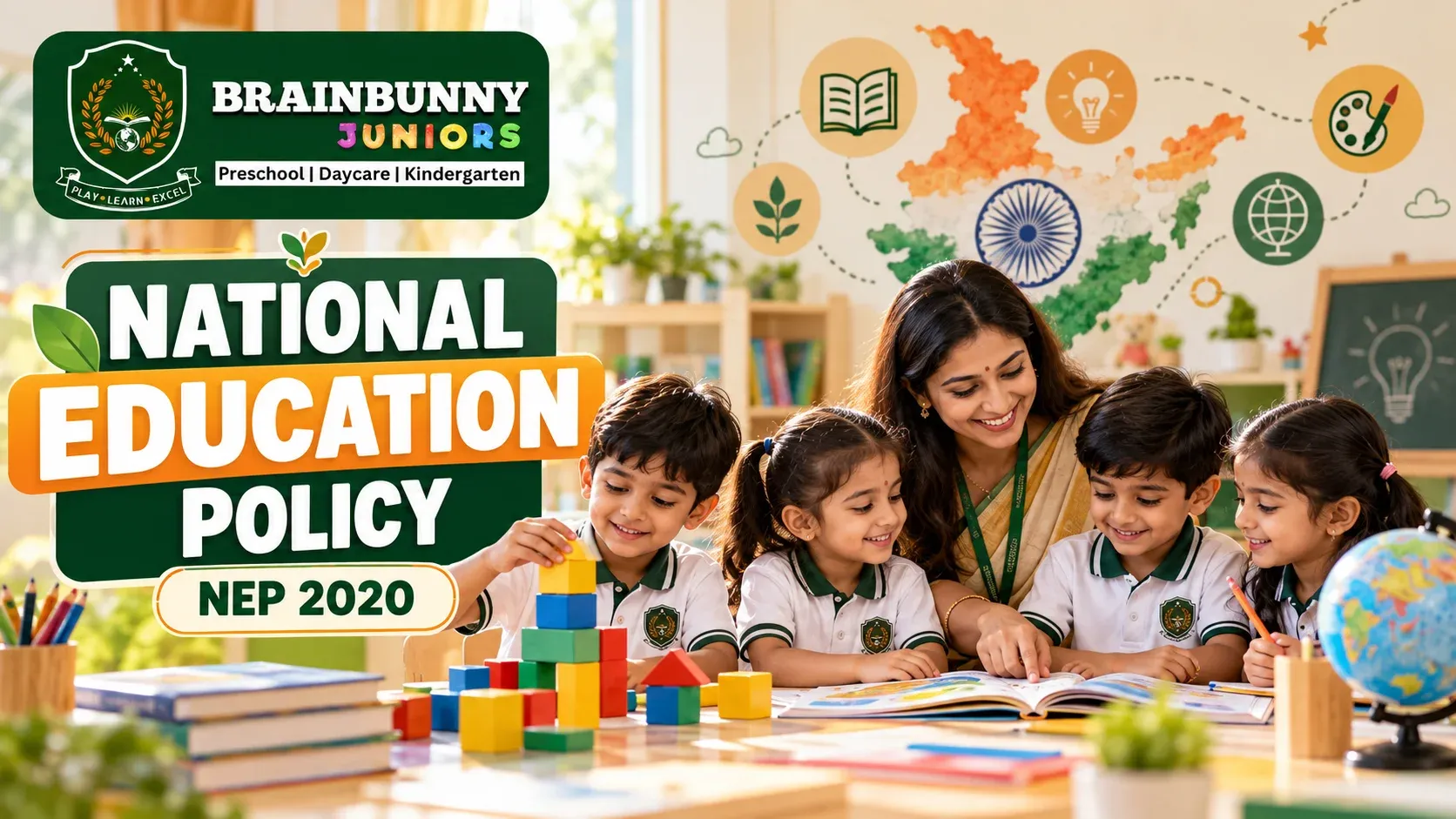
Understanding NEP 2020, the 5+3+3+4 education structure, Early Childhood Care and Education (ECCE), play-based learning and what parents should look for when choosing a preschool.
India’s approach to early childhood education is evolving, with greater emphasis on learning through play, language development, foundational literacy, numeracy and the overall development of young children. The National Education Policy (NEP) 2020 recognises the importance of the early years and places Early Childhood Care and Education (ECCE) at the centre of the country’s educational framework.
For parents choosing a preschool, understanding NEP 2020 can help them make informed decisions about their child’s first learning environment. Instead of focusing only on worksheets, writing practice or early academic performance, parents can look for schools that encourage curiosity, communication, creativity, physical development and social-emotional growth.
This guide explains what NEP 2020 means for preschool education in India, how the 5+3+3+4 structure works, why play-based learning matters, and what parents should consider when selecting an early learning centre.
What Is the National Education Policy 2020?
The National Education Policy 2020 is India’s education policy framework that outlines changes and priorities across school and higher education. One of its important priorities is strengthening Early Childhood Care and Education so that children receive a strong foundation before entering formal schooling.
NEP 2020 recognises that the early years are important for developing language, thinking, social interaction, physical coordination and foundational learning skills.
The policy proposes a shift towards developmentally appropriate, flexible and activity-based learning, particularly during the Foundational Stage.
In simple terms: NEP 2020 encourages early education to focus on how young children learn best—through play, exploration, interaction, stories, movement and meaningful experiences.
The policy is not a separate “NEP 2024.” The main national policy is NEP 2020. Subsequent frameworks and implementation initiatives, including the National Curriculum Framework for the Foundational Stage (2022) and the Aadharshila and Navchetna frameworks introduced in 2024, provide additional guidance for early childhood learning and development.
What Is the 5+3+3+4 Education Structure Under NEP 2020?
One of the most widely discussed changes under NEP 2020 is the 5+3+3+4 curricular and pedagogical structure. It is designed around children’s developmental stages rather than treating every school year in the same way.
The structure covers ages 3 to 18 and consists of four stages.
| Stage | Age group | Years covered | Main focus |
|---|---|---|---|
| Foundational Stage | 3–8 years | 3 years of preschool or Anganwadi/Balvatika, followed by Grades 1–2 | Play-based learning, language, early numeracy and overall development |
| Preparatory Stage | 8–11 years | Grades 3–5 | Activity-based learning with increasing classroom engagement |
| Middle Stage | 11–14 years | Grades 6–8 | Subject-oriented learning and exploration |
| Secondary Stage | 14–18 years | Grades 9–12 | Deeper subject learning, flexibility and critical thinking |
The Foundational Stage includes three years of preschool education followed by Grades 1 and 2. This is an important change in how early learning is viewed: preschool is recognised as an integral part of the child’s educational journey.
Why does this matter for parents?
The early years should not be treated simply as preparation for examinations or as a race to complete academic worksheets. Children need opportunities to develop communication, independence, motor skills, curiosity, relationships and early literacy and numeracy through age-appropriate experiences.
Source: Ministry of Education, National Education Policy 2020 and National Curriculum Framework for the Foundational Stage, 2022.
How Does NEP 2020 Affect Preschool Education in India?
NEP 2020 highlights several priorities that are relevant to preschool learning and school readiness.
1. Greater importance for Early Childhood Care and Education
Early Childhood Care and Education, commonly known as ECCE, covers the care, development and learning needs of young children.
Quality ECCE is broader than teaching letters and numbers. It supports physical well-being, communication, emotional security, social interaction, creative expression and early thinking skills.
A well-planned preschool environment should provide children with opportunities to explore, ask questions, interact with peers, practise everyday skills and develop confidence.
2. Play-based and activity-based learning
Young children often learn by doing. Building with blocks, listening to stories, sorting objects, singing, painting, role-playing and participating in movement activities can help them explore concepts in meaningful ways.
Play-based learning can support:
- Language and communication.
- Early mathematical thinking.
- Creativity and imagination.
- Problem-solving and curiosity.
- Fine and gross motor development.
- Cooperation, turn-taking and emotional awareness.
Play-based education does not mean learning without purpose. Teachers can plan activities around specific developmental goals while allowing children to explore and participate actively.
3. Foundational literacy and numeracy
Foundational literacy and numeracy are important priorities in NEP 2020.
For preschool children, early literacy may involve listening to stories, recognising sounds, learning new words, expressing ideas and becoming familiar with books. Early numeracy may include counting objects, recognising patterns, comparing sizes, sorting shapes and understanding simple quantities.
These activities should be appropriate for the child’s age and stage of development. Children do not all develop at the same pace, so teachers and parents should focus on progress rather than comparison.
4. Learning in the home language or familiar language
NEP 2020 emphasises the importance of using children’s home languages or familiar languages in the early years, wherever possible and appropriate.
When children understand the language used during learning, they may find it easier to express their thoughts, ask questions and participate in classroom activities.
Parents can support language development by talking with children, telling stories, singing songs and reading books in languages the family uses naturally. Exposure to additional languages can also be introduced in a supportive and age-appropriate way.
5. Holistic development rather than academic pressure
Preschool education should support the whole child, not just early academic performance.
Holistic development includes physical, cognitive, language, social, emotional, creative and ethical development. Everyday experiences such as sharing materials, completing a puzzle, listening to a story or taking part in group play can contribute to several areas at once.
Parents should therefore look beyond handwriting drills and memorisation when evaluating a preschool’s learning approach.
What Is Early Childhood Care and Education (ECCE)?
Early Childhood Care and Education refers to the care and learning experiences that support children’s development during the early years.
In India, ECCE includes different settings and services, such as Anganwadis, preschools and other early learning programmes. The setting may vary, but the goal is to provide age-appropriate opportunities for children to develop foundational skills in a safe, caring and stimulating environment.
ECCE may include:
- Language development through conversation, songs and stories.
- Early mathematical concepts through counting, shapes and patterns.
- Physical development through indoor and outdoor movement.
- Social skills through group activities and cooperative play.
- Creative development through music, art and imaginative play.
- Personal habits such as handwashing, tidying up and increasing independence.
- Emotional development through supportive relationships and guided interaction.
For parents, it is helpful to ask how a preschool plans activities, observes progress, communicates with families and responds to children with different developmental needs.
What Are the Aadharshila and Navchetna Frameworks Introduced in 2024?
Alongside NEP 2020, India has introduced additional guidance to support early childhood development and learning.
The distinction between the policy and these frameworks is important: NEP 2020 is the overarching education policy, while Aadharshila and Navchetna provide more specific guidance for different early childhood age groups.
Aadharshila: National Curriculum for Early Childhood Care and Education
Aadharshila is a national curriculum framework for Early Childhood Care and Education for children aged 3–6 years. It provides guidance for planning developmentally appropriate learning experiences for young children.
Its relevance to preschool education includes the emphasis on meaningful activities, play, interaction, language, exploration and the development of foundational skills.
Parents can use these principles as a starting point when asking a preschool how its daily programme supports children’s age-appropriate learning and development.
Navchetna: National Framework for Early Childhood Stimulation
Navchetna is a national framework focused on early childhood stimulation from birth to three years of age.
The first three years are important for responsive caregiving, sensory experiences, interaction, movement and early communication. Talking with babies, responding to their sounds, singing, sharing picture books and providing safe opportunities for movement can all contribute to early development.
For families with infants and toddlers, this reinforces the importance of nurturing care and age-appropriate stimulation, not just formal classroom instruction.
Parents should consult official Ministry of Women and Child Development resources for the full scope and guidance of these frameworks.
What Does Play-Based Learning Look Like in a Preschool?
Play-based learning combines purposeful teaching with opportunities for children to participate, explore and discover.
Here are examples of how common preschool activities can support learning.
| Preschool activity | Skills it can support |
|---|---|
| Storytelling and picture books | Listening, vocabulary, imagination and comprehension |
| Building with blocks | Spatial awareness, problem-solving and coordination |
| Sorting colours, shapes or objects | Classification, observation and early mathematical thinking |
| Music, rhymes and movement | Rhythm, memory, language and physical coordination |
| Art and craft activities | Creativity, fine motor skills and self-expression |
| Pretend play and role-play | Communication, imagination and social understanding |
| Outdoor games | Balance, movement, cooperation and confidence |
| Puzzles and matching games | Observation, persistence and problem-solving |
The value of an activity depends on how it is planned and facilitated. Teachers can support learning by asking open-ended questions, introducing new vocabulary, encouraging children to explain their ideas and adapting activities to different abilities.
A strong preschool programme should balance guided activities, child-led exploration, movement, rest and opportunities for social interaction.
How Can Parents Choose a Preschool That Supports NEP 2020 Principles?
Understanding NEP 2020 can help parents ask more useful questions when comparing preschools. However, the policy alone does not certify or endorse an individual preschool. Parents should evaluate each school’s actual practices, staff and facilities.
Consider these seven areas.
1. Learning approach
Ask how the school balances play, structured activities, stories, movement and early academic concepts.
Look for a programme that supports curiosity and age-appropriate development rather than relying entirely on rote memorisation or worksheets.
2. Teacher-child interaction
Observe how teachers communicate with children. Are they patient, attentive and encouraging? Do they listen to children’s questions and help them participate?
Warm, responsive interactions are an important part of a supportive learning environment.
3. Curriculum and daily routine
Ask for an overview of the daily schedule, learning activities, outdoor play, meals where applicable, rest periods and classroom routines.
Find out how activities are adapted for different age groups and how teachers share children’s progress with parents.
4. Language and communication
Ask how the preschool encourages children to communicate, develop vocabulary and engage with stories.
If your child is more comfortable in a particular home language, discuss how the school helps children settle in and express themselves.
5. Safety and hygiene
Check access controls, visitor procedures, hygiene routines, child-friendly infrastructure, emergency arrangements and supervision practices.
Ask how the school communicates incidents or concerns to parents. Verify any specific safety features directly rather than relying solely on marketing statements.
6. Emotional well-being and inclusion
Children may take time to adjust to a new environment. Ask how teachers support separation anxiety, encourage positive peer interaction and respond to children who need additional help.
A nurturing preschool should treat children with respect and communicate constructively with families.
7. Parent communication
Find out how frequently parents receive updates about learning activities, routines and developmental progress.
A useful parent-school partnership should make it easy to raise questions, discuss concerns and understand how the child is settling into the programme.
How Can Parents Support NEP 2020 Learning Principles at Home?
Learning does not happen only in a classroom. Simple everyday interactions can help children develop foundational skills and confidence.
Read together: Share picture books, describe illustrations and ask your child what they think might happen next.
Talk during daily routines: Use mealtimes, walks and household activities to introduce new words and encourage conversation.
Count naturally: Count toys, steps, fruits or building blocks. Compare sizes and notice patterns in everyday objects.
Encourage creative play: Provide safe materials for drawing, building, pretend play and simple craft activities.
Promote independence: Give children age-appropriate opportunities to put away toys, wash their hands with suitable supervision and make simple choices.
Make room for movement: Encourage safe outdoor play, dancing, ball games and activities that develop balance and coordination.
Avoid unnecessary pressure: Children develop at different rates. Celebrate effort, curiosity and progress rather than comparing your child with others.
Stay connected with teachers: Discuss your child’s interests, strengths, adjustment and any concerns so that home and school can work together.
These everyday experiences complement preschool learning. They do not require expensive materials or formal lessons to be meaningful.
Is NEP 2020 Relevant to Nursery, LKG and UKG?
Yes. The principles of NEP 2020 are relevant to early childhood learning and the transition into primary education, although the activities and expectations should reflect each child’s developmental stage.
Nursery
Nursery-age children may benefit from stories, rhymes, sensory exploration, language-rich interaction, movement, simple sorting and opportunities to develop independence.
Lower Kindergarten (LKG)
LKG activities may gradually introduce more structured experiences involving early literacy, counting, patterns, shapes, communication and problem-solving, while maintaining opportunities for play and exploration.
Upper Kindergarten (UKG)
UKG may provide further opportunities to strengthen language, early numeracy, listening, attention, fine motor coordination, collaboration and school-readiness skills.
These descriptions are general examples, not universal age or admission rules. Specific programme expectations vary by school and child. Parents should ask each preschool how it approaches age-appropriate development and transition to Grade 1.
Does NEP 2020 Mean Children Must Learn to Read and Write Earlier?
No. NEP 2020 does not mean that every child should be pushed into formal academic work at an earlier age.
The Foundational Stage emphasises developmentally appropriate, play-based and activity-based learning. Early literacy and numeracy matter, but children can build the foundations for these skills through conversation, stories, games, exploration and meaningful everyday experiences.
Parents should be cautious of claims that children must master a fixed set of academic skills unusually early to be successful. A balanced programme should support learning without unnecessary stress and should recognise differences in children’s development.
What Should Parents Ask During a Preschool Campus Visit?
Before enrolling your child, consider asking:
- What learning approach does the preschool use for my child’s age group?
- How are play, language, early numeracy and creative activities included in the daily routine?
- How do teachers monitor and communicate developmental progress?
- What steps are followed for child safety, hygiene and visitor access?
- How does the school help children adjust during their first few weeks?
- How are parents informed about activities, routines and concerns?
- What are the admission requirements, timings, fees and available programmes?
A campus visit gives parents an opportunity to see the environment, meet staff, understand routines and decide whether the preschool fits their child’s needs.
How BrainBunny Juniors Can Fit into Your Preschool Search
If you are exploring preschool options for your child, BrainBunny Juniors can be one of the schools you consider during your research. The most useful next step is to understand the programme available at your preferred centre and see whether its approach, environment, routine and communication style match your family’s needs.
When contacting a branch, parents can ask about available programmes, age eligibility, admission procedures, campus visits, daily activities, safety practices and fees.
You can explore the available information on the BrainBunny Juniors website, review the programmes page and check the branches page for centre-specific details. Confirm programme availability and other details directly with the relevant branch.
The right preschool choice is not simply about finding a school that mentions NEP 2020. It is about finding a learning environment that supports your child’s development, encourages curiosity and provides a caring partnership with parents.
Frequently Asked Questions About NEP 2020 and Preschool Education
1. What is NEP 2020 in simple words?
NEP 2020 is India’s National Education Policy. It outlines priorities for education, including strengthening early childhood education, encouraging foundational literacy and numeracy, and promoting learning approaches suited to children’s developmental stages.
2. What is the 5+3+3+4 structure under NEP 2020?
The 5+3+3+4 structure divides education into four stages: Foundational (ages 3–8), Preparatory (8–11), Middle (11–14) and Secondary (14–18). The Foundational Stage includes three years of preschool or equivalent early learning followed by Grades 1 and 2.
3. What is the Foundational Stage in NEP 2020?
The Foundational Stage covers children aged 3–8. It includes three years of preschool education and Grades 1 and 2, with an emphasis on play-based learning, language, foundational literacy and numeracy, and holistic development.
4. What is ECCE?
ECCE stands for Early Childhood Care and Education. It covers care, stimulation and learning experiences that support young children’s physical, cognitive, language, social and emotional development.
5. What is play-based learning?
Play-based learning uses purposeful games, stories, movement, exploration, creative activities and interaction to help children develop knowledge and skills. Teachers guide these experiences to support age-appropriate learning goals.
6. What are Aadharshila and Navchetna?
Aadharshila is a national curriculum framework for Early Childhood Care and Education for children aged 3–6. Navchetna is a national framework focused on early childhood stimulation from birth to three years.
7. Does NEP 2020 apply to preschool education?
Yes. NEP 2020 gives importance to Early Childhood Care and Education and includes three years of preschool within the Foundational Stage of the 5+3+3+4 structure.
8. Does NEP 2020 require formal reading and writing in preschool?
The policy emphasises foundational learning and developmentally appropriate education. Preschool learning should not be reduced to early formal academic drills; stories, conversation, play and hands-on activities can build important early literacy and numeracy foundations.
9. How can parents identify a preschool that follows NEP 2020 principles?
Parents can ask about the curriculum, play-based activities, language development, early numeracy, teacher-child interaction, safety practices and developmental progress reporting. They should verify a school’s actual practices rather than assuming that a policy mention proves compliance.
10. How can parents support NEP 2020 learning at home?
Parents can read with children, talk during daily routines, count everyday objects, encourage creative play, provide opportunities for movement and independence, and maintain communication with teachers.
11. Is NEP 2020 the same as NEP 2024?
No. India’s National Education Policy is NEP 2020. The Aadharshila and Navchetna frameworks introduced in 2024 provide additional guidance for early childhood care, education and stimulation.
12. How do I choose a preschool for my child?
Compare the learning approach, teacher-child interactions, daily routine, safety arrangements, communication with parents, programme availability, location and fees. Visit the campus and ask questions before making a decision.
Conclusion: Building a Strong Foundation for Lifelong Learning
NEP 2020 highlights the importance of the early years in a child’s educational journey. Through the Foundational Stage, play-based learning, early language development, foundational literacy and numeracy, and holistic development, the policy encourages a more developmentally appropriate approach to learning.
For parents, the practical takeaway is simple: choose a preschool that recognises children as active learners, supports their individual development, provides a safe and caring environment, and communicates openly with families.
If you are exploring preschool admission, take time to compare programmes, ask questions and visit your preferred centre. A thoughtful choice can help your child begin their learning journey with confidence, curiosity and a positive relationship with education.
Explore BrainBunny Juniors: Visit the programmes page, find a suitable branch, and contact the relevant centre to ask about admissions and campus visits.
This article is for general educational information. Parents should consult the relevant official frameworks and individual schools for current implementation details, admissions, programme eligibility and school-specific practices.