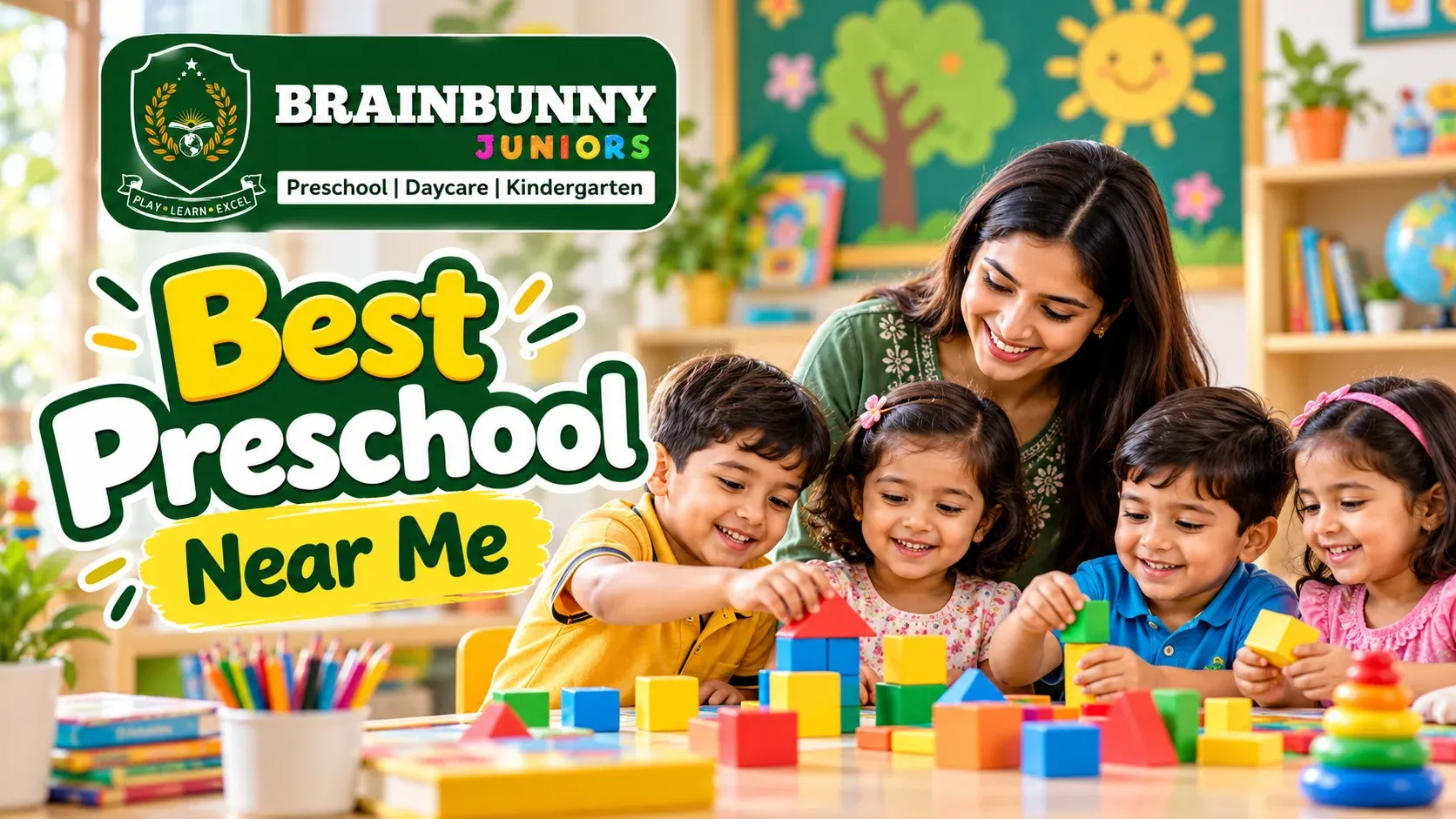
Searching for the best preschool near me is often the first step in finding the right learning environment for your child. Parents want more than a convenient location. They want caring teachers, age-appropriate learning activities, a safe environment, clear communication and a daily routine that works for their family.
With so many preschools, play schools, nursery schools and daycare centres available, choosing the right option can feel overwhelming. The best choice depends on your child’s age, developmental needs, comfort level, family schedule and the quality of the learning environment.
This guide explains how to find a preschool near you, what to check before admission, how preschool differs from daycare, which questions to ask during a campus visit, and how to explore nearby BrainBunny Juniors branches.
What Does “Best Preschool Near Me” Really Mean?
When parents search for “preschool near me” or “best play school near me,” they are usually looking for a convenient, suitable place where their child can begin learning, playing and interacting with other children.
However, the closest preschool is not automatically the best choice for every family.
A suitable preschool should offer a combination of:
-
Convenient location: A manageable daily journey from home or work.
-
Age-appropriate learning: Activities that match children’s developmental stages.
-
Caring educators: Teachers who communicate patiently and support children’s needs.
-
Safety and hygiene: Clear supervision, access procedures and cleanliness practices.
-
Social development: Opportunities for communication, cooperation and friendship.
-
Parent communication: Clear updates about routines, activities and concerns.
-
Transparent admission information: Details about programmes, timings, fees and eligibility.
The goal is to find a preschool that fits your child and your family—not simply the school with the most facilities or the strongest advertising.
Quick answer: To find the best preschool near you, shortlist nearby schools, compare their learning approaches and safety practices, visit the campuses, meet the teachers, and confirm programme availability, fees and admission requirements before making a decision.
How to Find a Preschool Near You
Finding a suitable preschool becomes easier when you follow a structured process instead of choosing the first result in a search.
Step 1: Search by your neighbourhood
Begin with searches such as:
-
Preschool near me
-
Best preschool near me
-
Play school near me
-
Nursery school near me
-
Daycare near me
-
Preschool admission near me
-
Preschool in your city or locality
You can also search by a residential sector, neighbourhood, nearby landmark or preferred commuting area.
For example, parents can use locality-specific searches such as “preschool in Noida Sector 122” or “preschool in Gurugram Sector 84” when looking for a centre in those areas.
Check the school’s actual address and route before deciding whether it is conveniently located. Search results and map listings may include centres that are farther away than expected.
Step 2: Compare the learning approach
Look beyond promotional descriptions and ask how the preschool organises its daily learning activities.
A balanced early-learning programme may include:
-
Stories, songs and language activities.
-
Art, craft and creative expression.
-
Counting, shapes, patterns and sorting.
-
Building blocks, puzzles and problem-solving games.
-
Music, movement and physical play.
-
Group activities that encourage cooperation.
-
Opportunities for independent exploration.
Play-based and activity-based learning can help children explore ideas in an age-appropriate way. Ask the school how teachers guide activities, encourage participation and observe each child’s progress.
Step 3: Check reviews and school information
Online reviews can help you identify questions to ask, but they should not be the only basis for your decision.
Look for specific, recent feedback about communication, daily routines, staff interaction and the admission experience. Check whether the school provides consistent contact details, an identifiable address and clear information about its programmes.
Whenever possible, visit the campus and speak directly with the school team.
Step 4: Shortlist two or three suitable schools
Create a shortlist based on location, learning approach, safety, timings and fees.
Visiting a few suitable schools can help you compare their actual environments instead of relying entirely on photographs or online descriptions.
Step 5: Book a campus visit
A campus visit allows you to see classrooms, observe the environment and discuss your child’s needs with the staff.
Ask whether you can learn about the daily schedule, meet the relevant teachers and understand the school’s procedures for settling in new children.
Step 6: Confirm admission details
Before paying fees or completing enrolment, confirm the programme, age eligibility, timings, fee structure, applicable charges, required documents and refund or withdrawal policy.
These details can vary by branch, programme and academic session, so request the latest information directly from the school.
What Should Parents Look for in a Good Preschool?
A good preschool supports learning while helping children feel comfortable, respected and encouraged.
1. A safe and child-friendly environment
Safety should be a central part of your evaluation.
During a visit, check:
-
Entry and exit controls.
-
Visitor management procedures.
-
Supervision during classroom and play activities.
-
Cleanliness of classrooms and washrooms.
-
Suitability of furniture and play equipment.
-
Safe drinking water and hygiene routines.
-
Emergency response and parent notification procedures.
-
How staff manage collection and handover at dismissal.
If the school advertises CCTV, biometric entry or other specific safety features, ask how the system works at that particular branch.
No single feature can guarantee safety. Parents should understand the school’s overall procedures and how responsibilities are managed.
2. Caring and attentive teachers
Teachers have a significant role in helping children adjust to preschool.
During your visit, observe whether educators listen to children, speak respectfully, encourage questions and respond calmly when children need help.
You can ask about staff qualifications, early childhood training, classroom supervision and how teachers communicate with parents.
A supportive teacher should help children participate without making them feel embarrassed about mistakes or differences in their learning pace.
3. Play-based and activity-based learning
Young children learn through interaction, exploration, repetition and meaningful experiences.
Look for a mix of guided activities and opportunities for children to explore independently.
For example, building with blocks can encourage problem-solving and spatial awareness. Storytelling can support listening and vocabulary. Art activities can encourage creativity and fine motor coordination.
Ask how the school balances these activities with routines, rest, movement and age-appropriate early academic learning.
4. A structured but flexible daily routine
A predictable routine can help children understand what happens next and gradually build independence.
Depending on the programme, the schedule may include arrival, free play, group activities, stories, creative work, snacks, outdoor play and rest.
Ask for a sample timetable and check whether it suits your child’s age and needs.
A suitable routine should provide structure without expecting young children to sit still for unnecessarily long periods.
5. Opportunities for social and emotional development
Preschool is often one of a child’s first opportunities to spend regular time with a group of peers.
Through guided group activities, children can practise sharing, taking turns, expressing feelings, listening and cooperating.
Ask how teachers help children who are shy, upset, reluctant to separate from their parents or still learning to interact with others.
Children may need different amounts of time to settle in, and a supportive transition process can make the experience more comfortable.
6. Clear communication with parents
Parent communication is important when a child is adjusting to a new environment.
Ask how the school shares updates about activities, routines, attendance, meals where applicable, and any concerns that need attention.
Find out how parents can contact the school, arrange a discussion with a teacher and receive information about their child’s progress.
Clear communication helps families understand what to expect and build a constructive partnership with educators.
Which Preschool Programme Is Right for Your Child?
The appropriate programme depends on your child’s age, developmental readiness, family needs and the eligibility criteria of the school.
Playgroup
Playgroup programmes generally introduce young children to group experiences, simple routines, sensory exploration, songs, movement and social interaction.
The emphasis is on helping children become comfortable in a learning environment and explore through play.
Nursery
Nursery programmes often build on early language, listening, observation, creativity, social interaction and basic mathematical concepts.
Activities may include storytelling, rhymes, sorting, matching, drawing and guided play.
Lower Kindergarten (LKG)
LKG programmes may introduce more structured learning experiences involving early literacy, number concepts, patterns, communication and fine motor skills.
Children should still have opportunities for movement, play and creative exploration.
Upper Kindergarten (UKG)
UKG programmes commonly build on foundational language, numeracy, communication, independence and classroom participation.
Parents should ask how the school supports the transition to Grade 1 and adapts activities to children’s individual developmental needs.
Important: Age ranges and admission cut-off dates vary between schools and academic sessions. Confirm the current eligibility criteria with your preferred branch instead of relying on a general age chart.
Preschool vs Daycare: What Is the Difference?
Preschool and daycare serve related but different needs. Some centres offer both services, while others provide only one.
| Feature | Preschool | Daycare |
|---|---|---|
| Main purpose | Early learning and development | Supervised care during the day |
| Typical activities | Stories, play, language and foundational learning | Play, rest, meals where provided, routines and age-appropriate activities |
| Schedule | Often organised around learning sessions | May offer longer care periods, depending on the centre |
| Family need | A structured early-learning experience | Care that fits the family’s daily schedule |
| What to confirm | Curriculum, age eligibility and school timings | Available hours, meals, rest, supervision and care arrangements |
For working parents, a preschool with daycare can be a convenient option if both services meet the child’s needs and the family’s schedule.
Before enrolling, confirm whether the same branch offers both services, the age groups accepted, operating hours, additional fees and how children transition between learning and care routines.
How Much Do Preschool and Daycare Fees Cost?
Preschool fees vary depending on the city, locality, programme, operating hours, facilities and services included.
Instead of comparing only the headline fee, ask each shortlisted school for a complete breakdown.
Check the following:
-
Registration or admission charges.
-
Tuition fees and payment frequency.
-
Learning materials, books or activity charges.
-
Uniform costs, if applicable.
-
Meals or daycare charges, where applicable.
-
Extended-care fees.
-
Deposit and refund conditions.
-
Any other compulsory charges.
Ask whether the fee quoted covers the complete programme or whether certain services are charged separately.
There is no single fee that applies to every preschool. Contact your preferred branch for its current fee structure and available programmes before making a comparison.
How Can Parents Check Preschool Safety Before Admission?
Online descriptions can help you prepare, but an in-person visit is useful for understanding how safety procedures work in practice.
Use this checklist during your visit:
-
Entry and exit: Ask how authorised pick-up persons are identified and how visitors are managed.
-
Supervision: Find out how children are supervised during classroom activities, outdoor play and transitions.
-
Staff procedures: Ask who is responsible for children at different times of the day.
-
Hygiene: Observe classroom cleanliness, washrooms and handwashing arrangements.
-
Emergency readiness: Ask how the school responds to illness, injuries or other emergencies.
-
Parent communication: Confirm how parents are informed about incidents or urgent concerns.
-
Food and allergies: If meals or snacks are provided, ask how dietary needs and allergies are handled.
-
Collection procedures: Understand the process for dismissal and handover to authorised adults.
Parents should assess the whole system, ask follow-up questions and verify advertised features rather than assuming that one facility alone establishes a safe environment.
Questions to Ask During a Preschool Campus Visit
Before making your final decision, ask the school these practical questions:
-
Which programmes are available for my child’s age?
-
What is the daily timetable?
-
How do teachers use play and activities to support learning?
-
What qualifications or training do the educators have?
-
How does the school help children settle in?
-
How are children supervised throughout the day?
-
What safety and emergency procedures are followed?
-
How are parents updated about daily activities and concerns?
-
What are the current fees and additional charges?
-
What documents are required for admission?
-
Is daycare available at this branch?
-
Can I review the refund, withdrawal and attendance policies?
Write down the answers so you can compare schools fairly after visiting each campus.
How to Prepare Your Child for the First Day of Preschool
Starting preschool can be an exciting change, but some children may need time to adjust.
Parents can make the transition easier with a few simple steps.
Talk positively about preschool. Explain that your child will have opportunities to play, explore, listen to stories and meet teachers and other children.
Build predictable routines. Practise suitable morning and bedtime routines before the first day.
Encourage small steps towards independence. Depending on age, let your child practise simple activities such as putting away toys, washing hands with suitable supervision or carrying a small bag.
Visit the campus when possible. Seeing the classroom and meeting a teacher beforehand may help your child become familiar with the environment.
Follow the school’s settling-in guidance. Ask what parents should expect during the first days and how the school communicates about adjustment.
Be patient with emotions. Some children settle quickly, while others need more time. Discuss ongoing concerns with teachers rather than comparing your child’s adjustment with other children.
Why Consider BrainBunny Juniors When Looking for a Preschool Near You?
If you are searching for a preschool, play school, nursery programme or daycare, BrainBunny Juniors is one option to explore as part of your decision-making process.
BrainBunny Juniors has a branch network across India. Parents can use the official branch finder to explore locations, check branch-specific information and contact the centre that best suits their needs.
Depending on the branch, families may be able to enquire about preschool programmes, nursery and kindergarten learning options, and daycare services.
When considering BrainBunny Juniors—or any preschool—parents should confirm the following directly with the preferred centre:
-
Which programmes are currently available.
-
The age eligibility and admission requirements.
-
The learning approach and daily routine.
-
The current fee structure and timings.
-
The facilities and safety procedures at that location.
-
Whether daycare is offered and what hours are available.
-
Whether a campus visit can be arranged.
Programme availability, facilities, timings and fees may vary by branch. A campus visit is a useful way to see the environment and ask location-specific questions.
Find Your Nearest BrainBunny Juniors Branch
Start by visiting the BrainBunny Juniors Branches & Locations page. Search for your city or area, open the relevant branch details and contact the centre to check available programmes and admission information.
You can also explore the preschool programmes or use the contact page for general enquiries.
Planning to enrol your child? Shortlist a suitable branch, ask about eligibility and fees, and arrange a campus visit before making your final decision.
Frequently Asked Questions About Finding the Best Preschool Near Me
1. How do I find the best preschool near me?
Search for preschools in your neighbourhood, compare learning approaches and safety procedures, read recent reviews, check programme availability and visit shortlisted campuses. Choose the school that best fits your child’s needs and your family’s daily routine.
2. What should I look for when choosing a preschool?
Consider location, teacher-child interaction, learning activities, safety procedures, hygiene, daily routines, parent communication, fees and admission eligibility. Visiting the campus can help you verify the information provided online.
3. What is the difference between a play school and a preschool?
The terms are often used interchangeably. Both may offer early learning through play, activities and social interaction. The actual programme, age groups and daily routine depend on the individual school.
4. What is the difference between preschool and daycare?
Preschool focuses primarily on early learning and development. Daycare primarily provides supervised care during the day. Some centres offer both, so parents should confirm the services, hours and charges available at the selected location.
5. At what age can a child start preschool?
The appropriate starting age depends on the programme, the child’s readiness and the school’s admission rules. Ask the school for its current age criteria and any applicable cut-off date before applying.
6. How much do preschool fees cost?
Fees vary by location, programme, facilities and schedule. Ask for a current fee breakdown that includes tuition, admission charges, learning materials and any additional daycare or service fees.
7. Is a preschool close to home a better choice?
A nearby preschool can make daily travel and drop-off routines easier. However, location should be considered alongside learning quality, safety, staff interaction, timings and your child’s needs.
8. What should I check during a preschool campus visit?
Observe the classrooms and play areas, ask about supervision and emergency procedures, meet teachers, review the daily routine and confirm fees and eligibility. You should also understand parent communication and child handover procedures.
9. How can I check whether a preschool is safe?
Ask about visitor management, authorised pick-up procedures, supervision, hygiene, emergency response and parent notification. Verify specific advertised features during your visit and assess the overall safety procedures.
10. Does BrainBunny Juniors offer preschool and daycare?
BrainBunny Juniors has preschool and daycare options across its network, but services vary by location. Check the official branches page and contact your preferred centre to confirm availability, timings and eligibility.
11. How do I enquire about BrainBunny Juniors admission?
Visit the Branches & Locations page, select your preferred location and contact the relevant centre. Ask about available programmes, age criteria, fees, timings and campus visits.
12. Should I visit a preschool before admission?
Yes, when possible. A visit lets you see the environment, meet staff, ask questions and assess whether the school’s approach and daily routine suit your child.
Conclusion: Find the Right Preschool for Your Child
Finding the best preschool near you is about more than distance, facilities or online ratings. It means choosing a learning environment where your child can explore, communicate, develop confidence and gradually become comfortable with new routines.
Start with your preferred neighbourhood, shortlist a few schools, check their programmes and safety practices, compare fees and visit the campuses. Take time to ask questions and verify the details that matter to your family.
If you are considering BrainBunny Juniors, use the official branch finder to explore available locations and contact your preferred centre for admission details.
Your next step: Find a convenient branch, ask about the right programme for your child and arrange a campus visit to make a more informed decision.